
Fourteen webbed murals
May every webbed, quilted, checkered, triangular painted layer on a wall (and paper) set that space free

The first part of this newsletter is a BULLETIN BOARD with upcoming and current shows, projects, book releases and events, that I hope you will come to and share with your communities.
And the second part is ROOTS, WEBS, NETS, and BRANCHES. A written offering, sharing of work, expansion & footnotes of what’s going on in my studio, practice and brain. This part is for paid subscribers.
ROOTS WEBS NETS BRANCHES BULLETIN BOARDS is my practice, is labor, is my work.
BULLETIN BOARD
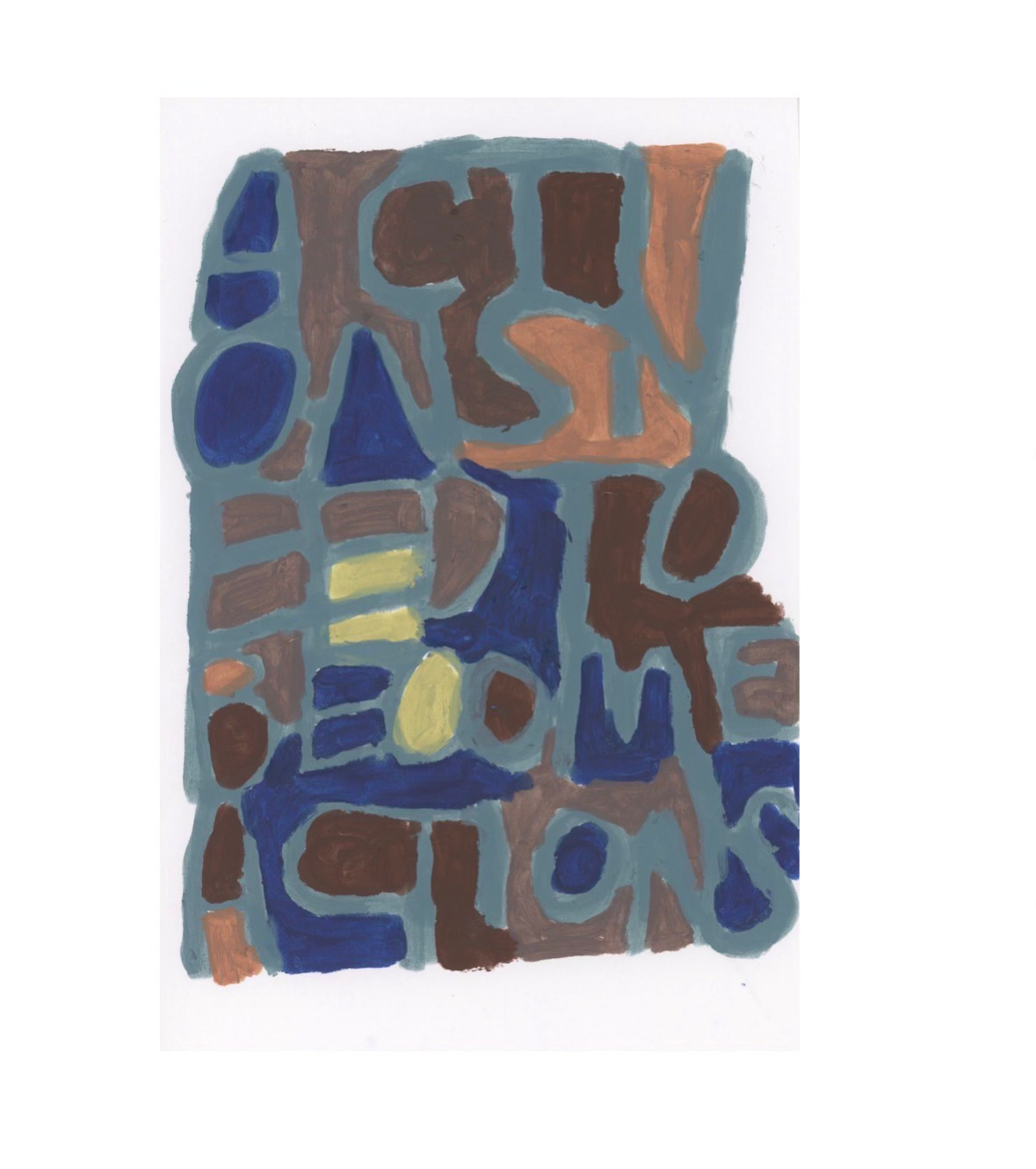
For over three years this body of work has been emerging, taking form, collecting research, growing words and webbings itself. I am beyond excited to get to share this work with my many communities. Throughout Steadfast Study there are a series of special collaborations, a forthcoming publication by Cripple/ Emily Sara, a written conversation by way of letters with Katie Giritlian and a sound score that doubles as an audio description at times with Izzy Johnson. I hope you can come and spend time in this show, study space, sound score, webbed home, over the course of its run until June 28, 2026. Please reach out to me/the gallery if you would like to bring your poetry group, class or affinity group, I want to spent time within the work and hear what is coming up for y’all!
May 2- June 28, 2026, Public opening reception: Saturday, May 2, 5-7pm
September Gallery, Kinderhook, NY
In the words of my dear comrade and friend, Katie Giritlian,
“Steadfast” a word of discernment, of clarity, of precision achieved through a “lifelong voice to fight.” “Study” a word of abundance, of expansion, of porous possibilities made through collective learning and exchange. These two words together make room for living with, and within, collective struggle and liberation. These two words together both make clear and expansively hold what artist, abolitionist, educator, storyteller and cultural worker Lukaza Branfman-Verissimo extends to us: a series of multidisciplinary works that broadcast the life of language and its inevitable transformation when we take part in Steadfast Study together. Sandwich board paintings, murals, prints, broadsides, a book, an ecosystem—Branfman-Verissimo’s works are made of the language, material and breath of what it means to gather together inside of each and every pulse that makes liberation.
STEADFAST STUDY announces. In the entrance of September Gallery lives the artist’s collection of sandwich board paintings, announcing and welcoming us to gather here. Amassing multiple signs together, Branfman-Verissimo reroutes the rules of signage to choreograph new cues and new views, readying our breath for the openness needed to speak to and with collective care.
STEADFAST STUDY chants. In the largest room of the gallery, big enough to hold us all within, lives the mural series and a site specific mural on the walls. Together, these works transform the many voices and teachers of STEADFAST STUDY into a tapestry where language is made larger together, where words break free to return to each other, where “different strategies are fighting for the same goal.”
STEADFAST STUDY dwells. On the other side of the gallery is a room to study within. Here lives the artist’s debut publication, ‘Steadfast Study’, published by Cripple and produced by September Gallery, that archives and disperses Branfman-Verissimo’s writings around the artist’s role within liberation movements. This publication, alongside a series of prints and painted broadsides, disperses language for hosting our study. As we dwell in the intimacy of book and prints, we hear an audio piece that gives a sonic voice to the language in and across the works of the show.
STEADFAST STUDY exchanges. A conversation between Branfman-Verissimo and their friend and collaborator, Katie Giritlian, takes form through letters, back and forth as they talk through the themes of Branfman-Verissimo’s show and practice at large.
All together, STEADFAST STUDY offers us windows, ways, words that invite us to speak, breathe, and hum with the life (and lifelong) work of collective struggle and liberation.
Access Note:
To enter use the entrance located at the Northside of The Knitting Mill Building via the parking lot. At the Northside entrance there is a glass door with a handle. Once in the building, turn right to follow signs pointing you towards the stairwell/ elevator to the gallery. The gallery is located on the third floor of the mixed use building. To use the elevator, please press the call button. The button will have a blue light that goes off when the elevator has arrived. To enter the elevator, open the door and let it shut behind you, the door will lock, wait for the accordion doors to close on their own and press the button for the floor that you wish to access. If you need to unlock the elevator door press the button for the floor that you are already on. If you choose to take the steps, there are three banks of stairs with hand railings. The first bank has seventeen stairs, the second bank of stairs has four steps and the third bank of stairs has twelve. The floors of the gallery are a smooth wood surface. There is one non ADA accessible gender neutral bathroom in the gallery and two ADA accessible gender neutral bathrooms on the ground floor by the elevator. For the duration of Steadfast Study, KN95 masks will be required to be worn in the gallery. We have masks provided in the space, thank you for keeping the artist and community safe!
January 30- June 28, 2026
Smith College Museum of Art, Northampton, MA
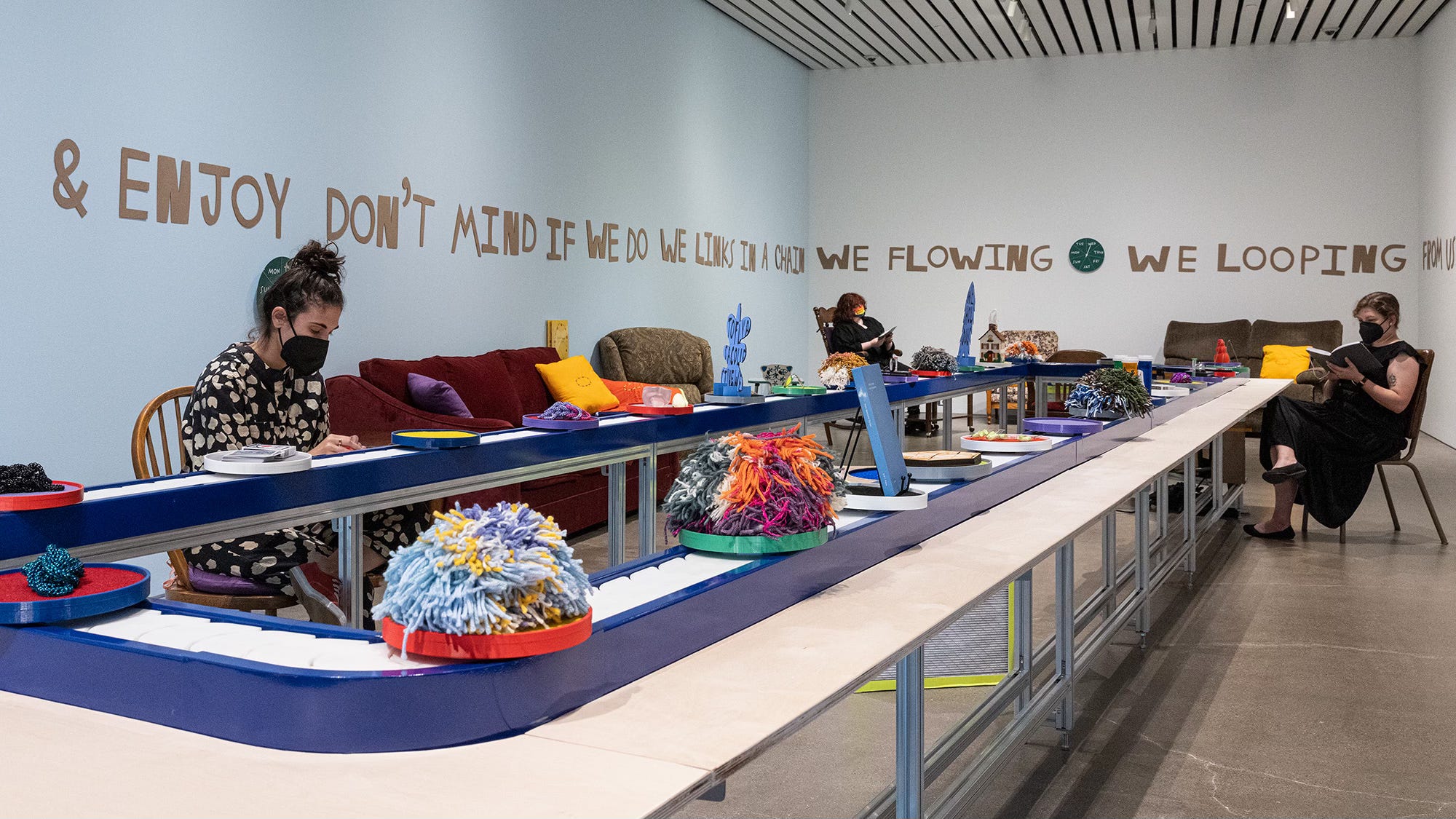
Finnegan Shannon is an artist whose mischievous works challenge traditional museum practices and etiquette. For Don’t mind if I do, Shannon brings alive their longtime fantasy for an exhibition that meets their access needs. “I’m disabled,” they say, “and I need to sit. I’ve been dreaming about an exhibition where instead of having to move from artwork to artwork, I could sit somewhere comfortable and have the artwork come to me.”
Don’t mind if I do is a collaborative experiment demonstrating how temporary changes in power structures create pathways of access for visitors, artists, and staff. Anchored by a conveyor belt that brings artworks to visitors who are invited to sit around comfortable furniture and engage with the objects, the exhibition features artworks by a selection of artists who have influenced Shannon’s practice. The paraded objects, including plastic pill bottles, tissue box covers, and gender-affirming packers, signify illness, systems of support, and play within everyday life.
Embraced for its efficiency and mechanized transport of goods, the conveyor belt is reappropriated as a vehicle for cultivating a more relaxed museum-going experience. It welcomes informality, messiness, and unsettling the hierarchy of objects.
This text was written by Denny Mwaura for Gallery 400 at the University of Illinois at Chicago based on texts by Finnegan Shannon and Lauren Leving and is used with permission.
Artists in the show: Lukaza Branfman-Verissimo, Pelenakeke Brown, Sky Cubacub, Emilie L. Gossiaux, Felicia Griffin, Joselia Rebekah Hughes, Jeff Kasper and Finnegan Shannon. As well as, Rooted, drawings from architect Phyllis Birkby’s archives.
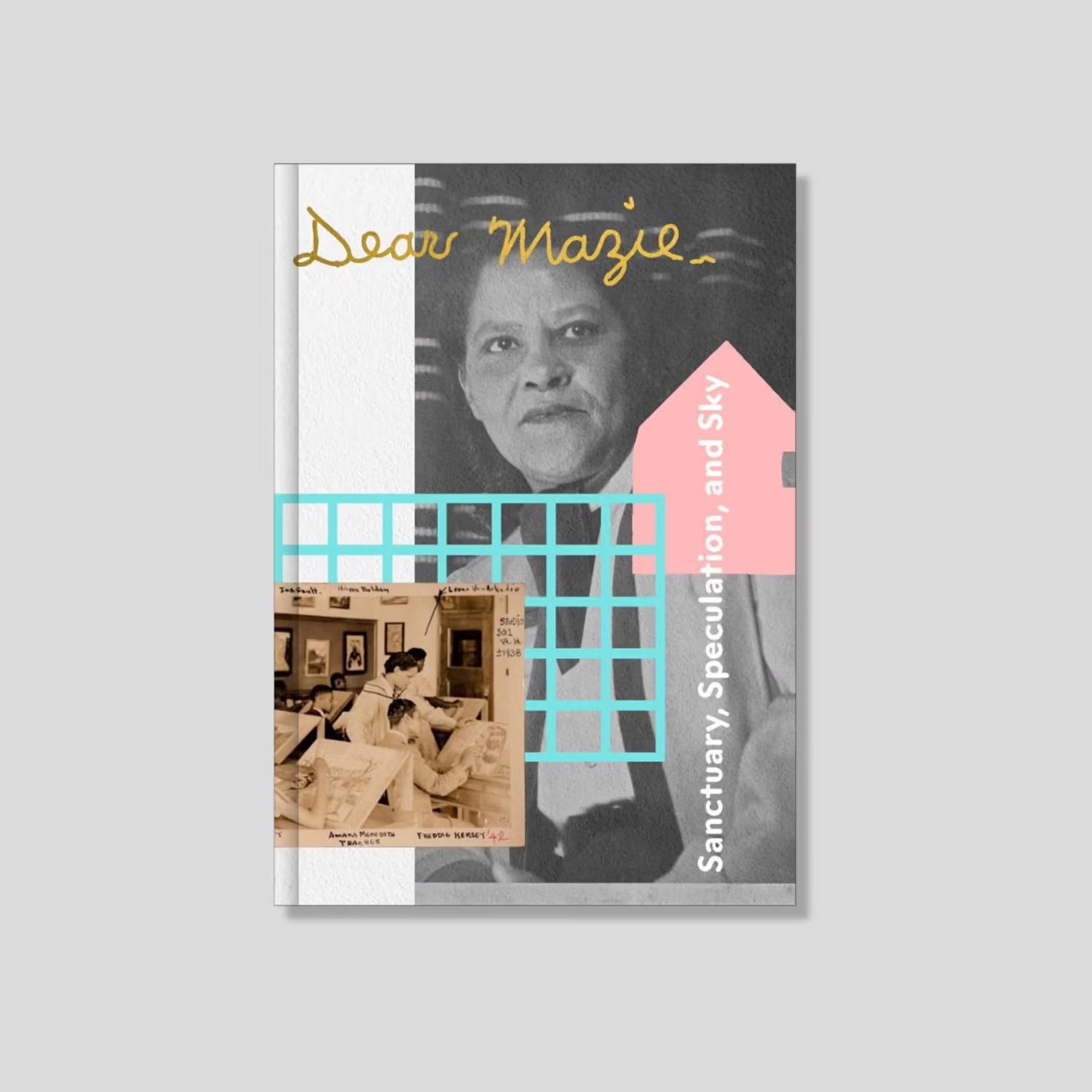
Dear Mazie,: Sanctuary, Speculation, and Sky
Edited by Amber Esseiva, Published by CARA and Institute for Contemporary Art at Virginia Commonwealth University
Coming out in Summer 2026
Dear Mazie,: Sanctuary, Speculation, and Sky is an experimental reader that explores the work and legacy of Amaza Lee Meredith (1895–1984), a trailblazing artist and educator who became the first known Black queer woman to practice as an architect in the United States.
The publication accompanies the eponymous exhibition at ICA VCU, which takes Meredith’s expansive letter-writing practice as a conceptual framework for epistolary responses in the present. Dear Mazie, plots Meredith’s life and work within themes of placemaking, gender, sexuality, and Black love, with a special focus on the ways she built sanctuaries (from homes to institutions to communities) for herself and other people of color to foster rigorous artistic pursuit, free of persecution.
The fully illustrated publication features previously unpublished photos, blueprints, letters, and scrapbooks from Meredith’s archives and an annotated timeline of her life and work. Newly commissioned essays from architectural scholars, and oral histories with former students, colleagues, and friends explore her significant legacy in public education, the arts, modernist architecture, and the built environment in the context of school desegregation, civil rights, and land and property rights. Contributions from a diverse group of contemporary artists respond to Meredith’s legacy, offering a note to the past from the present.
Featuring new works by Jessica Bell Brown, Amber Esseiva, Mario Gooden, Mabel Wilson, Colson Whitehead, Charisse Pearlina Weston, and Craig Wilkins, Interviews by AD-WO (Emanuel Admassu, Jen Wood), Regenia Perry, Reverend Grady Powell, Steve Williams, and Alexis Pauline Gumbs, Artwork by Lukaza Branfman-Verissimo, Abigail Lucien, Tschabalala Self, Cauleen Smith, The Black School (Joseph Cuillier and Shani Peters), Kapwani Kiwanga
ROOTS, WEBS, NETS, BRANCHES


For the past six years I have painted fourteen murals on walls, windows, roll up doors, in small galleries and larger than life walls, as commissions, in public facing store fronts, exhibitions and in collaboration with the sun. One permanent piece and thirteen temporary works, up for a limited duration, a month, a season, a week, a year. Murals have become a rooted part of how I share my work. A painted wall or window is an extension to how I think about the role of the making of multiples, of broadcasting language and public facing dialogue.
Keep reading with a 7-day free trial
Subscribe to ROOTS WEBS NETS BRANCHES BULLETIN BOARDS to keep reading this post and get 7 days of free access to the full post archives.